In part 1, I pointed out that part of the support for the KJV Bible is founded on the argument that the Textus Receptus is a special text that God protected. The English Anglicans then translated that text, thus preserving God’s true word. Behind the argument concerning the transmission of the Textus Receptus is the implied idea that all other textual traditions contain some mistakes. Some textual traditions contain more mistakes, and some, like the Majority Text, contain fewer mistakes. But anything other than the Textus Receptus is an inaccurate Bible.
It was but a short step from this claim to the claim that the use of critical studies on the Old and New Testament texts is an example of sinful corruption. After all, we have the correct text in the KJV. Thus, any eclectic text is not only ipso facto wrong but also an example of deliberate human sinfulness. The critical method does have its problems, and they are not minor.1 That is a subject for another post. So, the Doctrine of Preservation became an anti-critical studies doctrine. No critical studies of any type were to be countenanced, especially if the weight of the evidence brought into question the Textus Receptus. Thus, to the person committed to the Doctrine of Preservation that the story of the woman caught in adultery is not found in any early edition of the Gospel of John means that only deficient early versions of the manuscripts survived. Early copies of the true version did not survive, but the true version was passed on nonetheless.2
Here, we switch over to the language used. This is not an argument about the KJV text but rather about the translation itself. In order to support the idea that the KJV was a special God-given translation, the English language, grammar, and phonaesthetics used in the KJV also became regarded as special over the last four centuries by the supporters of the KJV. Thus, an article found online claims:
- The King James Bible contains God’s Built-in Dictionary, defining each word, in its context, using the very words of the Webster’s and Oxford English Dictionaries!
- The King James Bible has a vocabulary and reading level which slowly builds progressively from Genesis to Revelation.
- The King James Bible uses words with the appropriate sound symbolism. It has a vocabulary that phonaesthetically fulfills the Bible’s own description of itself as “powerful”.
- The King James Bible is the only extant access we have to the pure language lexicons of the 16th and 17th centuries.
- The King James Bible gives a transparent view of the Greek and Hebrew vocabulary, grammar and syntax.
- The King James Bible has internationally recognizable vocabulary and spelling.
- The King James Bible uses literary devices which enhance doctrinally important concepts and memorability.
- The King James Bible has a sentence structure which enhances accurate doctrinal interpretation.
- The King James Bible’s words and sentences are patterned and woven through its fabric so as to provide a consistency of form and content.
- The King James Bible has the precision and longevity of the legal document that it is. (To be equitable all English speaking persons must be judged by the same criteria.)3
As you can read, the argument is no longer about the Hebrew and Greek texts used. Over the last four centuries, the claim began to be made and grew into a claim that the very translators were inspired in a special way so that the English they used went beyond itself to create a new English masterpiece. The second set of arguments that develops is about the translation choices made by the English translators, choices which allegedly not only were guided by the Holy Spirit but also led them to create a new almost-dialect of English perfect for communicating the truths of God’s Word. To repeat, we have moved from the Hebrew and Greek text of the KJV. The argument is no longer about the Textus Receptus. The argument has now become an argument about the English used in the translation. It is a new and perfect English for the Bible.4
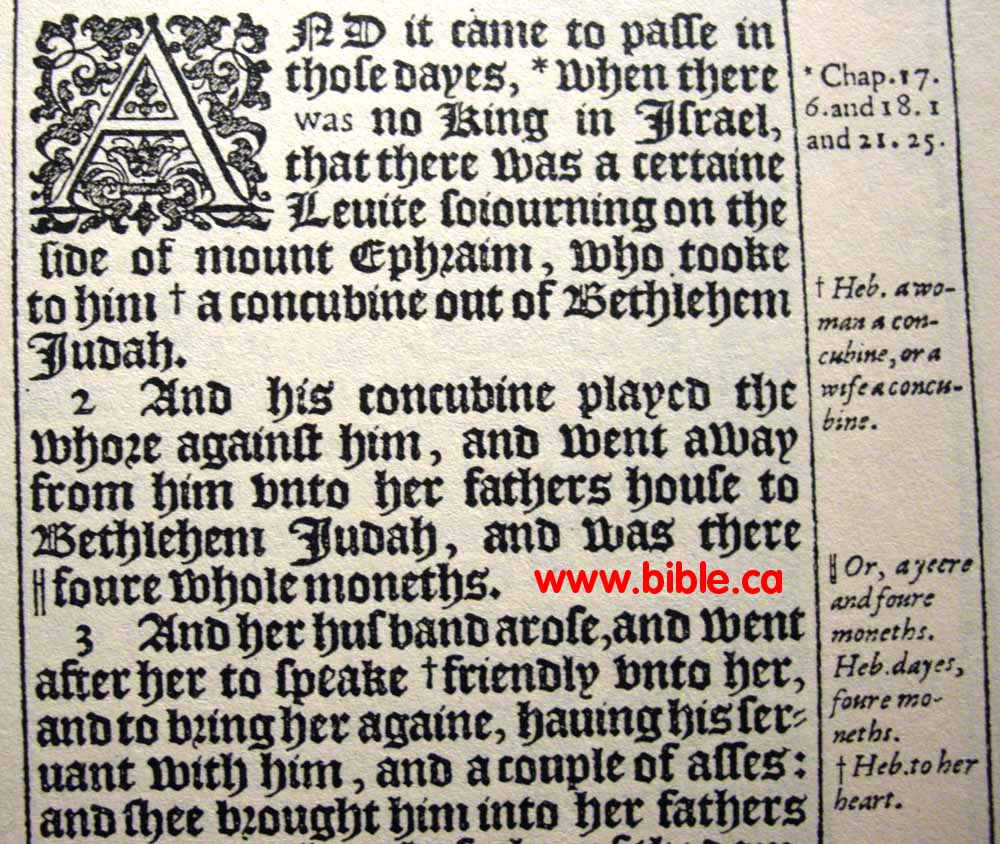
Originally, there was no such argument about the KJV English. It was merely regarded as a translation that was especially fine. As the language changed, revised editions of the KJV were issued to bring the language used up to the current usage. So, as the language changed, “and it came to paffe in thofe dayes,” was changed to, “and it came to pass in those days.” The acknowledged last edition was either in 1762 or in the very early 1800s.5
Editions of the KJV stopped until 2016, once Bibles that were no longer pure Textus Receptus Bibles began to be produced. However, in 2016, a new edition of the KJV was published after a pause of two and a half centuries (assuming 1762 to be the last edition). This version is called the KJV 2016.6 The KJV 2016 is based on the same Textus Receptus used for the original KJV. However, it is notable in that it does not use revised Elizabethan English but current Modern English. Thus, it returns to the tradition of using current English to translate the Textus Receptus, which was the norm up through 1762.
The final question: what about the use of Elizabethan English in worship texts? Note that this is not a question about the KJV. We are past the KJV. Now, the question changes to the use of revised Elizabethan English in writing worship texts. The answer is rather interesting. The same English who produced the KJV also produced The Book of Common Prayer for the Church of England. So, of course, it was written in the language of the day, which was Elizabethan English. Eventually, the 1662 Book of Common Prayer became the standard prayer book of the Church of England. It holds that status to this day. All the Modern English of the Church of England editions are considered to be “alternative forms.”7 It may be of interest to the reader that in many parts of the Anglican Communion, the 1662 is still recognized as official. The 1979 Book of Common Prayer of The Episcopal Church USA still had the option of Rite I, which is basically the 1662 rite.
The American Puritans also had a hand in the use of revised Elizabethan English in worship. The use of the Geneva Psalter as the hymnbook of their churches and records of their prayers and sermons show a deep and devotional use of revised Elizabethan English. So deep was the impact of their prayers and writings that their writings are still read to this day. “The Reformed Pastor” by Richard Baxter, a Nonconformist English Puritan who never left England, is a book still recommended to this day in many seminaries.8
Thus, the language of prayer in the English Empire, and even in America, became revised Elizabethan English. But why do some refuse to use Modern English in their prayerbooks? Do some of your looking up on the web. You will find that there are still articles being published on how reformed Elizabethan English is better. The arguments range from “it makes me feel better to use it (paraphrased)” to “Modern English has done away with the difference between the second person singular and plural, therefore minimizing the intimacy of talks with God (paraphrased).” The OCA had an interesting reply to the revised Elizabethan English question, and it is worth reading:
In recent years, the transition to a more contemporary English seems to be taking place. New texts issued by the OCA, St. Vladimir’s Seminary, and elsewhere seem to abandon the use of Thee and Thou while retaining a certain elegance of style.
So I would say that we are in somewhat of a period of transition right now with the following considerations at hand:
Despite the presence of an official Liturgy translation, parishes and clergy are not forced to employ it, and a wide variety of translations are in use in various places. [Perhaps the parish you attend is not, in fact, using the official translation, since you mention that Elizabethan style is employed there and the offical translation, while based on the RSV translation, is not Elizabethan.]9
So, there is no conundrum for the OCA, as mentioned in part 1. Rather, there is a certain amount of flexibility in approaching worship texts, though most parishes would lean toward revised Elizabethanism. The GOA has changed to Modern English, though I believe some of their less frequently issued prayer books are still found in revised Elizabethan English. The OCA article mentions that there was a committee of inter-jurisdictional bishops formed a couple of decades ago whose purpose was to prepare a joint liturgical approach. As mentioned in the article, nothing more has been heard from that committee. The AOC is firmly in the revised Elizabethan camp and no Modern English.
My ideal would be more of the OCA approach. If we are going to become one jurisdiction in the USA and Canada, we are going to need to allow variety, with local parishes deciding whether to use reformed Elizabethan or current Modern English. At larger-than-the-local-parish meetings, the bishop would decide. I think the conundrum mentioned in part 1 need not be a conundrum if we recognize that there is already widespread use of both revised Elizabethan and current Modern English.
- Epp, Eldon Jay. “The Eclectic Method in New Testament Textual Criticism: Solution or Symptom?” The Harvard Theological Review 69, no. 3/4 (1976): 211–57. http://www.jstor.org/stable/1509033. [↩]
- Please note that there is additional complexities to the arguments back and forth. This is merely a short summary. [↩]
- https://avpublications.com/product/the-language-of-the-king-james-bible/ [↩]
- Notice that no claim is being made about what language to use in worship, only about what English orthography was used in the KJV itself. [↩]
- The edition of 1762 is acknowledged by everyone. There are claims of American orthographical corrections in the early to mid-1800s, but I have not been able to fully corroborate that. [↩]
- https://kjv2016.textusreceptusbibles.com/ [↩]
- https://en.wikipedia.org/wiki/Book_of_Common_Prayer [↩]
- Baxter Richard and William Brown. 1974. The Reformed Pastor. Edinburgh: Banner of Truth Trust. [↩]
- https://www.oca.org/questions/parishlife/archaic-english [↩]