“Beauty is a terrible and awful thing! It is terrible because it has not been fathomed, for God sets us nothing but riddles. Here the boundaries meet and all contradictions exist side by side.” — Fyodor Dostoevsky, The Brothers Karamazov Have you ever considered what beauty is? So have many philosophers. Let me give you […]
Atheist and tracts
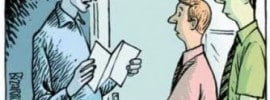
Father Orthoduck saw this cartoon on another of his favorite bloggers, Orthodixie. He had quite a laugh over it. Then Father Orthoduck looked at it some more and realized that while the cartoon is funny, it actually is not fully truthful. Atheists have put out many pamphlets and even books. For instance, Bertrand Russell, a […]
But you can’t fool all of the people all of the time
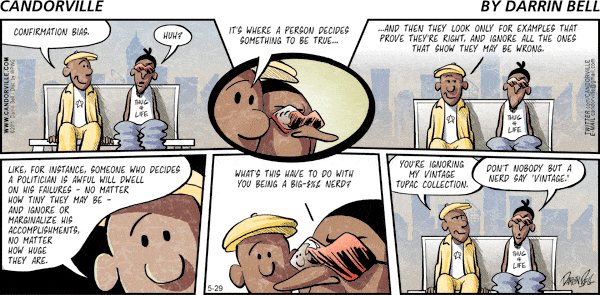
OK, so let’s get to the nitty gritty of these various posts. After Kuhn showed how even science was somewhat dependent on one’s worldview and showed how major advances did not tend to happen until somebody looked at the data with a different worldview, other philosophers began to look again at the whole issue of language […]
And you can fool some of the people all of the time
Yesterday I had mentioned that another philosophy came up that caused an explosion within USA culture. Remember that I mentioned a philosopher named Kuhn? His book was published in the 1960’s, in the midst of the cultural explosions that did not begin in the 1960’s as most people think, but began in the 1950’s (well, […]
You can fool all of the people some of the time
I mentioned yesterday that a philosopher named Kuhn came up with the terminology “paradigm shift.” And, I mentioned that what he conclusively showed was how even scientists are influenced by some of their preconceptions. Let me put it another way. If any of you have read the original Sherlock Holmes novels–not the movies, please, the […]
God forgive him, but not me, because I could not beware
For who deceives me once, God forgive him; if twice, God forgive him; but if thrice, God forgive him, but not me, because I could not beware. — 1611 Tarlton’s Jests [English “modernized” to make it readable] Yesterday I pointed out that several events had led to the loss of the concept of truth in […]
Fool me twice . . . rethink your approach to truth
Yesterday I quoted from a book by a priest whom I know. In it he said: Let me submit to you, therefore, that the great spiritual battle of our time is not a struggle between believers and atheists. Rather, it is a struggle between pride and humility. We expect and even demand humility in almost […]
For Want of a Nail
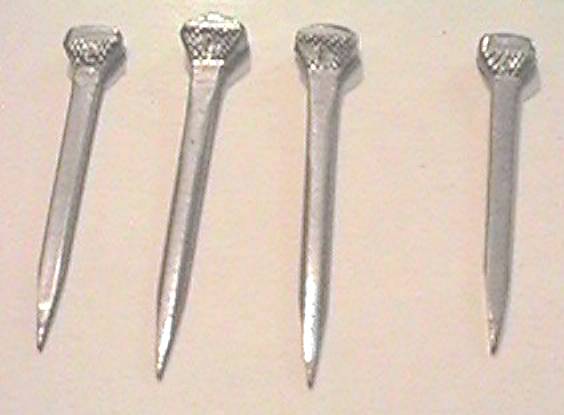
For want of a nail the shoe was lost. For want of a shoe the horse was lost. For want of a horse the rider was lost. For want of a rider the battle was lost. For want of a battle the kingdom was lost. And all for the want of a horseshoe nail. The […]
On news analysis
Yesterday Father Orthoduck commented on how often our interpretation of the Scriptural end times is influenced by our culture, our political beliefs, and our theological beliefs. That is why the Church’s Ecumenical Councils are always multicultural and multi-ethnic. Everything in the Christian life is a mixture of humanity and divinity. We are often quite unaware […]
A good article on Europe and Christian heritage
Normally, I do not post articles written by other people in their entirety. But, this article is worth the effort to post here. Mostly, I tend to heavily critique American Christian political conservatives for many stances that worry me. But, this is a very nice article and critique of Europe, whose Christian problems are the […]
- 1
- 2
- 3
- 4
- Next Page »


